True to the Law of Sod, a few days after The Birdwatcher’s Yearbook 2027 went to press, two institutions published revisions that have a, thankfully, minor significance for the checklist published in The Yearbook.
To wit
14th October 2026
An announcement by the British Ornithologists’ Union Records Committee (BOURC) changed the categories in which certain species are placed. It does not, however, add or remove any species from the list, lump or split any, or change the sequence. It therefore makes very little practical difference to the list published in The Yearbook.
For the record, it states.
Red Grouse (Lagopus scotica) added to Category C2
Snow Goose (Anser caerulescens) removed from Category C2
Canada Goose (Branta canadensis canadensis) added to Category C5.2
Mandarin Duck (Aix galericulata) added to Category C5.2
Refer to
page 97 of The Birdwatcher’s Yearbook 2027
and to
https://bou.org.uk/british-list/changes-to-the-british-list-14-oct-2026/
for an explanation of what these categories mean and fuller details of why the changes have been made.
The BOURC will integrate these changes into their next update of the British List, due to be published in January 2027.
20th October 2026
Publication by AviList, the organization that the BOURC now uses as the taxonomic authority for the British List, of its 2026 version. The changes made in this 2026 version have not yet been adopted by the BOURC for the British List, but it is likely that they will be when the BOURC publishes its next update in January 2027.
Although the actual 2026 version of AviList was published after the 2027 edition of The Yearbook went to press, the AviList website (www.avilist.org) provided advance details of the possible changes that were under consideration and the reasons why they were being considered. It did not, however, provide a definitive statement as to whether any of these possible changes would or would not ultimately be adopted. The possible changes that were of relevance to the British List were flagged up on page 99 of The Birdwatcher’s Yearbook 2027 as changes that might possibly be made in the course of late 2026 or 2027.
Of the possible changes flagged up in The Yearbook:
· The Eurasian Wren has been moved to a new genus, Nannus, and its scientific name is now Nannus troglodytes rather than Troglodytes troglodytes.
· The Two-barred/White-winged Crossbills (Loxia leucoptera [leucoptera/bifasciata]) have not been raised from subspecies to species and the Two-barred Crossbill (Loxia leucoptera [bifasciata]) entry therefore remains unchanged.
· The genus Emberiza (Buntings) has been split into four genera: Fringillaria, Schoeniclus, Melophus and Emberiza. Three of these have representatives on the British list and the generic names of British buntings are now:
o Schoeniclus
o Pallas’s Reed, Reed, Yellow-browed, Chestnut, Yellow-breasted, Little, Rustic and Black-faced.
o Melophus
o Black-headed and Red-headed
o Emberiza
o Corn, Chestnut-eared, Rock, Ortolan, Cretzschmar’s, Cirl and Pine, and Yellowhammer
o In all cases, the specific name remains unchanged.
o There are no buntings on the British list in the genus Fringillaria.
· Subspecies of two further species on the British List European Robin (Erithacus rubecula) and Spotted Flycatcher (Muscicapa striata) have been raised to species rank. However, the subspecies in question have not been recorded in the UK and therefore these changes will have no impact on the British List.
· Just so you know, the Tenerife Robin is now Erithacus superbus (I think I’d be tempted to log it as Superb Robin on my list), the Gran Canaria Robin is now Erithacus marionae, and the Mediterranean Flycatcher is now Muscicapa tyrrhenica.
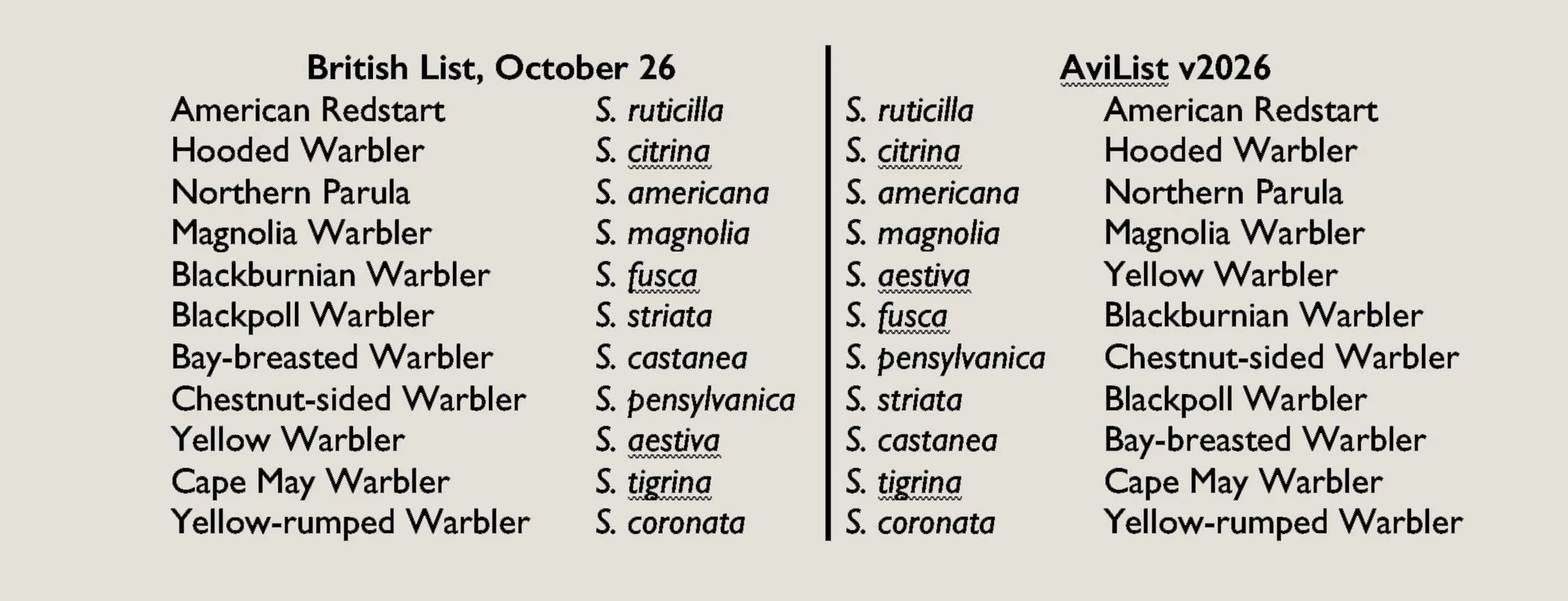
Setophaga (New World Warblers)
The sequence in which five of the eleven Setophaga species on the British List are listed has been revised in AviList v2026. The table below shows the current sequence in the British List and the sequence in AviList v2026 for those species that are on the British List. The latter sequence will presumably be adopted when the British List is next updated in January 2027